Our consultation model
Children’s emotional health and wellbeing has a huge impact on their ability to learn. One in ten children and young people aged 5 to 16 have a clinically diagnosed mental health disorder and around one in seven has less severe problems.
A whole-school approach is vital to improving children’s emotional health and wellbeing, helping to keep them safe, improve behaviour and raise achievement. Our objective is to provide a whole school approach for ensuring that mental health and wellbeing becomes central to the way schools work, in providing resources and educational programs to enable pupils to become emotionally-resilient and mentally healthy.
Our mental health delivery helps schools to promote positive mental health in their pupils and identify and address those with less severe problems at an early stage and build their resilience.
In order to help their pupils succeed, NeuroHeadway offers a role to play in supporting them to be resilient and mentally healthy.
Our training to teachers and pupils provides consistent and quality service based programs to promote positive health. These programs encompass:
- Wellbeing interventions to support students experience psychological and mental health issues
- Pupil development and wellbeing together with cognitive therapy courses
- Professional therapeutic interventions, using creativity to support the most appropriate course of action for the student
- Psycho-education mindfulness and stress reduction courses
- Delivering a telephone call back service, providing information and advice on service interventions and services available in the wider community
- To contribute to service development and a culture of continuous improvement
- To contribute to the promotion of the service in the community
- Anti-Bullying, peer support service
- Restorative approaches
- Whole school anti-bullying strategies
- Developed curriculum resources on personal development and resources
- Reviewed and provided support on policies in schools
- Guidance and pastoral care
- Improve health and wellbeing and academic progress
This service also helps schools identify and support pupils with more severe needs and help them make appropriate referrals to specialist agencies such as: Child and Adolescent Mental Health Services (CAMHS), where necessary.
The key areas guiding our whole school approach for developing emotional health and wellbeing (EHWB) are:
- Getting a shared understanding and commitment to change and development
- Building relationships and developing practices with individual schools
- Implementation and evaluation
Where chronic problems occur, our practitioner or psychologist will be able to advice you with and additional support elsewhere, including from medical professionals working in specialist Child and Adolescent Mental Health Services (CAMHS), voluntary organisations and local GPs.
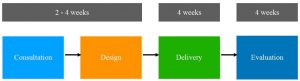
1. Consultation
Our practitioner will meet with the Head of the School to discuss:
- the current school environment
- areas of focus for mental health support
- measurements of success for our interventions
The practitioner will then consult with teachers to identify priority support topics and understand individual class needs before introducing themselves to the children.
Consultation is vital as it will inform how we design our resources, deliver them in the school and evaluate the effectiveness of our intervention. You will have direct contact with our experienced practitioner who will guide you through the process and respond to your needs.
2. Design
Once we have established the needs of your school, we will design a programme of learning interventions based on our comprehensive mental health resources. Materials will be adapted and created so they are appropriate for your children and their environment.
After the programme of learning is agreed, our practitioner will meet with individual classes and begin providing workshops.
3. Delivery
Each of the classes identified will receive one workshop per week, for a total of four weeks during school hours. Our practitioner will work closely with your teachers to ensure the learning is engaging and effective.
After each workshop our practitioner will complete a reflection summary, so that each intervention builds upon the last. These reflections will also be incorporated into our evaluation process and will help you to sustain positive change following our support.
4. Evaluation
We will undertake an evaluation process that will:
- engage with staff, children and their parents
- measure the effectiveness and quality of our interventions
- explain to parents what has been achieved with their children and how they can support it further
